Saturday, 22 December 2012

Facebook tests paid messages to strangers

How much would you pay to contact a stranger? Facebook is sprucing up its messaging system, and the most interesting change is a move to charge people to send a message to someone outside their network.
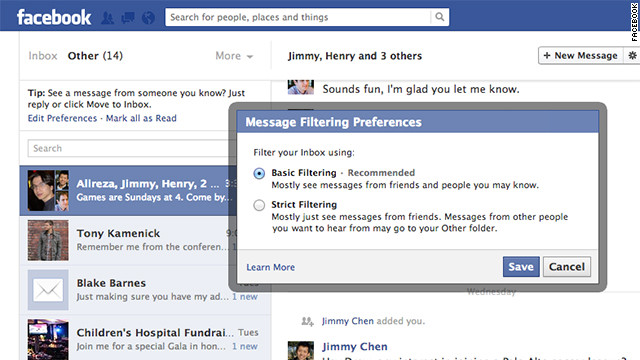

New changes to Facebook's messaging system include the ability to set filters on which messages you see.


These unlucky missives are dropped in the little-known "Other" folder, where they will often spend the remainder of their digital existence unseen, unread and unloved.

Facebook is now testing a solution to help messages avoid this limbo, the company announced in a blog post Thursday. People can pay to circumvent the dreaded "Other" folder and have their messages show up directly in the recipient's inbox. The cost to send one message will be a dollar, according to AllThingsD.

In a post announcing the changes, Facebook points out that this could be helpful for people who want to contact someone about a job or reach out to anyone else they may not have a personal connection to. Charging could also help cut down on unwanted spam, according to Facebook.

"Several commentators and researchers have noted that imposing a financial cost on the sender may be the most effective way to discourage unwanted messages and facilitate delivery of messages that are relevant and useful," says the post.

The "inbox delivery test" will be available only to select people using Facebook in the U.S. for now. Companies won't have access to the feature at this time, and people are limited to one paid outgoing message a week to minimize abuse.

The social network is also rolling out new filtering options for the inbox. If you select Basic Filtering, the usual messages from friends and people in your extended network will go to the inbox. With Strict Filtering, it will be "mostly" limited to messages from friends.

The update also allows members to receive messages from the Messenger for Android app, a mutual friend throwing a party and anyone with your @facebook.com e-mail address.

Facebook is constantly trying to find new revenue streams, testing out services such as paying to promote posts and Facebook Gifts. The pay message option is being tested out for a few months, but if it is popular, it could be an interesting way for the site to address spam and make some money at the same time.


Collected from (CNN) --

Steve Jobs' yacht impounded over pay dispute

The Venus, a 100-million-euro ($137.5 million), 260-foot-long yacht, made its unofficial debut in late October. It's currently stuck in the Port of Amsterdam after Starck hired a debt-collection agency to attempt to remit the final payment for his design.

Late Apple co-founder Steve Jobs' yacht was unveiled in a Dutch shipyard in October and christened
Late Apple co-founder Steve Jobs' yacht was unveiled in a Dutch shipyard in October and christened "Venus."

According to lawyers at Ubik -- Starck's design company -- speaking with Reuters, the designer has only received 6 million of the 9-million-euro commission and is seeking the rest of the payment before the Venus will be released.
"These guys [Jobs and Starck] trusted each other, so there wasn't a very detailed contract," Roelant Klaassen, a lawyer for Ubik, told Reuters.

The Venus is a floating ode to both Jobs and Starck's minimalist aesthetic. Made entirely out of aluminum, with 40-foot-long floor-to-ceiling windows lining the passenger compartment and seven 27-inch iMacs making up the command center.

In Walter Isaacson's biography of Jobs, the late Apple CEO is quoted as saying that, "I know that it's possible I will die and leave Laurene with a half-built boat, but I have to keep going on. If I don't, it's an admission that I'm about to die."


Earth's biodiversity map updated for first time since 1876

A 'life map' of biodiversity showing the organisation of terrestrial life on Earth has been updated after more than a century.
The original map, drawn up by British naturalist Alfred Russel Wallace in 1876, was the first attempt to depict the myriad ways life has evolved on the world's continents.
Thanks to advances in modern technology and data on more than 20,000 species, scientists from University of Copenhagen have now produced a next generation map depicting the organisation of life on Earth.

The new map provides fundamental information regarding the diversity of life on our planet and is of major significance for future biodiversity research.
The new global map shows the division of nature into 11 large bio-geographic realms and shows how these areas relate to each other. It is the first study to combine evolutionary and geographical information for all known mammals, birds and  amphibians, a total of over 20,000 species.
The attempt to describe the natural world in an evolutionary context was made in 1876 by Wallace, the co-discoverer of the theory of natural selection, along with Charles Darwin.
"Our study is a long overdue update of one of the most fundamental maps in natural sciences. For the first time since Wallace's attempt we are finally able to provide a broad description of the natural world based on incredibly detailed information for thousands of vertebrate species," said researcher, Ben Holt in a statement.
The new map can be split into finer geographical details for each class of animals. It is made freely available to contribute to a wide range of biological sciences, as well as conservation planning and management of biodiversity.

Modern technology like DNA sequencing and a tremendous compilation of hundreds of thousands of distribution records on mammals, birds and amphibians across the globe has made it possible to produce the map.
"The map provides important baseline information for future ecological and evolutionary research. It also has major conservation significance in light of the on-going biodiversity crisis and global environmental change," said Jean-Philippe Lessard, the other co-lead-author of study.
"This holistic description of the natural world that we provide could be a new cornerstone in fundamental biology," senior researcher Carsten Rahbek, director of the Center for Macroecology, Evolution and Climate added.

Rare meteorite that exploded in US was fastest to hit Earth

A meteorite that exploded as a fireball over the US earlier this year was among the fastest and rarest meteorites to have hit the Earth, travelling a highly eccentric route to reach our planet.
Researchers led by UC Davis, SETI Institute and NASA found that the meteorite - a carbonaceous chondrite - that fell over California's Sierra foothills on April 22 was the rarest type known to have hit the Earth.
It is composed of cosmic dust and presolar materials that helped form the planets of the solar system.
Scientists learned that the meteorite formed about 4.5 billion years ago and was knocked off its parent body, which may have been an asteroid or a Jupiter-family comet, roughly 50,000 years ago.

As it flew toward Earth, it travelled an eccentric course through the solar system, flying from an orbit close to Jupiter toward the Sun, passing by Mercury and Venus, and then flying out to hit Earth.

The high-speed, minivan-sized meteorite entered the atmosphere at about 102998 km per hour. The study said it was the fastest, "most energetic" reported meteorite that's fallen since 2008, when an asteroid fell over Sudan.
"If this were a much bigger object, it could have been a disaster. This is a happy story in this case," said researcher Qing-zhu Yin in a statement.

Before entering Earth's atmosphere, the meteorite is estimated to have weighed roughly 45359.2 kg. Most of that mass burned away when the meteorite exploded.
Meteorites like Sutter's Mill are thought to have delivered oceans of water to the Earth early in its history.

Using neutron-computed tomography, researchers helped identify where hydrogen, and therefore water-rich fragments, resides in the meteorite without breaking it open.
For the first time, the Doppler weather radar network helped track the falling carbonaceous chondrite meteorite pieces, aiding scientists in the quick recovery of them, the study reports. Yin expects that the weather radar data in the public domain could greatly enhance and benefit future meteorite recoveries on land.
"For me, the fun of this scientific gold rush is really just beginning," said Yin.


Amazon Web Services to accommodate big data storage


Eyeing the growing market for big data analysis, AWS (Amazon Web Services) has introduced a storage package, called High Storage, that can offer fast access to large amounts of data.
High Storage, an Amazon EC2 (Elastic Compute Cloud) package, is designed to run data intensive analysis jobs, such as seismic analysis, log processing and data warehousing, according to the company. It is built on a parallel file system architecture that allows data to be moved on and off multiple disks at once, speeding throughput times.
[ Stay on top of the current state of the cloud with InfoWorld's special report, "Cloud computing in 2012." Download it today! | Also check out our "Private Cloud Deep Dive," our "Cloud Security Deep Dive," our "Cloud Storage Deep Dive," and our "Cloud Services Deep Dive." ]

"Instances of this family provide proportionally higher storage density per instance, and are ideally suited for applications that benefit from high sequential I/O performance across very large data sets," AWS states in the online marketing literature for this service. The company is pitching the service as a complement to its Elastic MapReduce service, which provides a platform for Hadoop big data analysis. AWS itself is using the High Storage instances to power its Redshift data warehouse service.

An AWS instance is a bundle of compute units, memory, storage and other services configured to the characteristics of a particular type of workload. High Storage is the ninth type of compute instance that AWS has introduced. It joins other instant types customized for particular workloads, such as instances optimized for using GPUs (graphics processing units) or for HPC (high performance computing) jobs.

The High Storage instance offers 35 EC2 compute units of compute capacity and 117GB of working memory. Up to 48TB of storage is spread across 24 direct attached storage hard disk drives. Spreading data across multiple disks can speed data transfers because the read-and-write speed of a single disk is no longer a bottleneck. The system can offer more than 2.4GB per second of sequential I/O performance.

Customers can evoke High Storage instances from the AWS Management Console, from the EC2 or Elastic MapReduce command lines, or from the AWS SDK or third-party libraries. The High Storage instance is currently available on the U.S. east coast and will be available in other parts of the world in the next few months. High Storage instances can be purchased ether on-demand or be reserved ahead of time at reduced cost.
Further helping potential big data-minded customers, Amazon has also turned on its data pipeline for general use, which the company announced last month.

Joab Jackson covers enterprise software and general technology breaking news for The IDG News Service. Follow Joab on Twitter at @Joab_Jackson. Joab's e-mail address is Joab_Jackson@idg.com


Proposed law would stop broadband data caps that 'undermine innovation'


Proposed law would stop broadband data caps that 'undermine innovation'In the name of promoting online innovation and protecting consumers, U.S. Senator Ron Wyden (D-Ore.) this week introduced a law that would restrict ISPs' use of data caps -- limits on how much customers can upload and download on their smartphones and computers -- solely to addressing network congestion. The proposed legislation, called "The Data Cap Integrity Act," comes in the wake of a study from non-profit group The New America Foundation, which concluded that data caps on broadband usage serve only to bilk customers and stifle online innovation, rather than ensuring that Internet data travels the network lines unfettered.

"This bill is intended to help consumers manage their data more effectively and ensure that data caps are used only to serve the legitimate purpose of addressing congestion," Wyden said in a statement, adding that "data caps should not impede this innovation and the jobs it creates."


Through the Data Cap Integrity Act, the FCC (Federal Communications Commission) would establish industrywide data measurement accuracy standards as to how ISPs measure data usage; the law would also give the FCC the power to ensure that data caps are designed to manage network congestion, "rather than [to] monetize data in ways that undermine online innovation," according to Wyden.

The law would require ISPs to provide consumers with tools for managing their data consumption, and it would prevent ISPs from discriminating against any content; that is, giving favored treatment to their own services over similar services from competitors. "Data caps ... run the risk of undermining innovation in the digital economy if they are imposed bluntly and not designed to truly manage network congestion," Wyden said.

According to The New American Foundation's study, data caps don't address network congestion as ISPs have claimed. That sort of congestion stems from high levels of traffic on networks during peak hours; the critical factor is the time of day when a person uses data, not how much data a person consumes over the course of a month. Even Comcast admitted to the FCC in a disclosure document that data caps "do not address the issue of network congestion, which results from traffic levels that vary from minute to minute."
Rather, the study found that data caps serve to potentially undermine competition:
They serve to protect carriers' legacy services by discouraging consumers from accessing content online that they traditionally consumed offline. For example, customers are turning to services like Netflix, Hulu, and Crackle to watch movies and shows, rather than turning to standard cable.


"[O]ver the longer term, consumption-based billing could reduce the attractiveness of over the top video options (e.g., Netflix and Hulu), as the economic attractiveness of such over-the-top options could be partially offset by a [broadband] bill that is higher, due to [broadband] overage charges that would be driven by large amounts of data being streamed via a customer's [broadband] connection," cautioned a 2011 presentation from Credit Suisse.

In challenging the law, expect ISPs to point to a report (PDF) out of Michigan State University, funded by the National Cable & Telecommunications Association. According to the report, written by Steven Wildman, a professor of information studies, "the effects of well-designed [usage-based pricing] plans on consumers are likely to be beneficial, as are the effects of UBP on investments in the broadband infrastructure."

Funded by The National Cable & Telecommunications Association, the paper -- titled "The Economics of Usage-Based Pricing in Local Broadband Markets" -- also argues that the revenue ISPs garner from data plans "will likely contribute to better cash flows and stronger incentives to invest in broadband plant, both to improve the quality of service for current customers and to extend networks into unserved and underserved territories."

This story, "Proposed law would stop broadband data caps that 'undermine innovation'," was originally published at InfoWorld.com. Get the first word on what the important tech news really means with the InfoWorld Tech Watch blog. For the latest developments in business technology news, follow InfoWorld.com on Twitter.


RIM caves to Nokia's patent demands with hopes pinned on BlackBerry 10


While the high-profile mobile patent bout between heavyweights Apple and Samsung likely has many more rounds to go, the undercard match between Nokia and RIM today came to an abrupt -- and arguably merciful -- conclusion: The winner is Nokia, as RIM has submitted to a patent license agreement for an undisclosed sum.

RIM caves to Nokia's patent demands with hopes pinned on BlackBerry 10According to an announcement from Nokia, the two companies have entered an agreement that settles all existing patent litigation between the organizations and ends legal battles in the United States, United Kingdom, and Canada. The financial structure of the agreement includes a one-time payment and ongoing payments, all from RIM to Nokia, according to the announcement.

Nokia filed patent claims in the United States and Germany against RIM (as well as HTC and ViewSonic) last May, alleging the companies infringed on a number of patents. The company last month also sought a ban on certain RIM products with wireless LAN capabilities.

Nokia and RIM may have settled so that they could focus their resources and efforts on their respective struggles in staying relevant in the mobile market. Nokia has seen itself lose market share as it's struggled to become a purveyor of Windows smartphones. Sales of the company's older Symbian-based phones, meanwhile, have plunged. According to a recent report from IHS, Nokia has lost the title of top phone maker to Samsung.

RIM, meanwhile, has suffered steadily plummeting sales and is pinning its very future on the success of the forthcoming BlackBerry 10. Fortunately for the company, the OS has garnered praise from developers and analysts.


This story, "RIM caves to Nokia's patent demands with hopes pinned on BlackBerry 10," was originally published at InfoWorld.com. Get the first word on what the important tech news really means with the InfoWorld Tech Watch blog. For the latest developments in business technology news, follow InfoWorld.com on Twitter.